

A measured position on AI

The loudest adopters are rarely the smartest operators.
Over the past two years, AI has been positioned as a universal cure-all. Headlines promised growth hacks. Platforms promised transformation. Agencies promised speed. The pressure to move was everywhere, and many organizations ran toward it way too fast and far too underprepared.
At MDG, we chose a different path.
Strategic patience. Active testing. Governance before deployment. Outcomes before theater.
This is not a defensive posture. It is a deliberate one. And the distinction matters. Because in the industries we serve, the cost of getting it wrong is not a bad press release. It is eroded trust, regulatory exposure, and brand damage that takes years to repair.
What is the Disappointment Gap?
There is a gap between where AI has been marketed and where it performs. We call it the disappointment gap. It is widening for the organizations that moved without a plan, and for those still waiting on the sidelines, trying to determine where to jump in.
The reason is structural, not superficial. These models are trained on the open web. By design, they are built to aggregate and synthesize the broad center of available information. It creates a “Regression to the Mean,” and that is visibly seen as increasing numbers of Marketing and Content teams are blindly adopting new tools. This aggregation is both their strength and their limitation. In practice, what they produce tends to regress toward the mean.
The truth is: average doesn’t win market share.
For agencies serving regulated industries like healthcare, senior living, and financial services, average is not just uncompetitive. It is a liability. Generic AI outputs create generic brand presence, and generic brand presence in trust-dependent categories is a race to the bottom.
The organizations that moved with urgency but without discipline are now sitting in the disappointment gap. Wondering why their AI tools haven’t delivered the transformation that was promised. The chart below captures this dynamic precisely.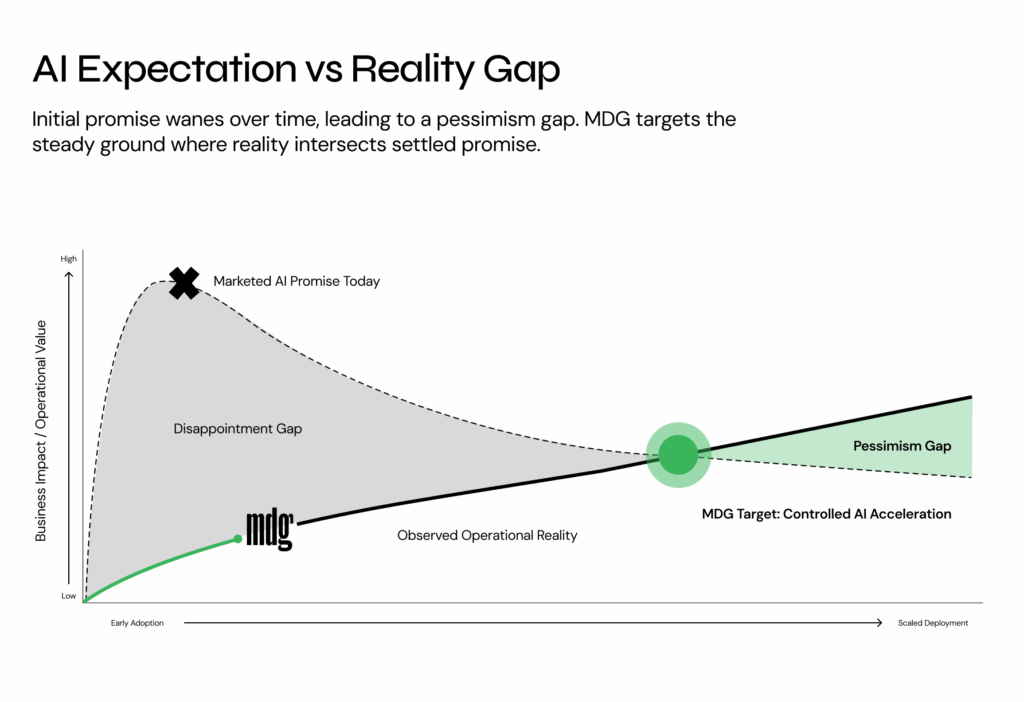
MDG targets the steady ground where operational reality intersects with settled promise. Controlled AI acceleration, not reactive adoption.
MDG sits on the trend line. Not behind it. Not ahead of the hype. On it, moving with intention and tracking where reality and predictable value intersect.
Are the Stakes Different in Regulated Industries?
Absolutely. Healthcare and compliance-heavy verticals do not have the same margin for error as a direct-to-consumer brand running a viral campaign. The risk calculus is fundamentally different.
Move too fast, and you expose clients to unnecessary regulatory risk, brand safety failures, and audience trust erosion. Move too slowly, and you invite irrelevance. Competitors will capture ground you conceded while you waited.
The right posture is to operate precisely along the trend line. Where new technology actually improves outcomes, reduces costs, and maintains the caliber of strategic and creative rigor that clients in these industries require.
That is not caution. That is discipline. And in regulated industries, it matters.
Our Operating Principle: Outcomes Over Theater
This is the core of how we operate. Not a slogan. An operating principle.
Innovation Theater is the practice of deploying unproven tools or AI-powered systems for the sake of signaling progress. Broadcasting innovation rather than delivering it. We see it constantly. An agency bolts an AI layer onto a deliverable, adds a badge to their pitch deck, and calls it strategy.
It isn’t strategy. It is theater.
What we must be hyper-aware of is the difference between AI-enabled and AI-strategic. A tool is not a strategy. An architect does not design a building around the power of the drill. The architect designs around the outcome the building must deliver, then selects the right tools to build it. We are not building around tools. We are building around outcomes.
We deploy systems selectively, where they can be governed, measured, and retired if they fail to deliver results. Speed-to-insight and insight-to-action are the metrics that matter. Not platform adoption counts. Not AI mentions in a status report.
Systems over stunts. The horizon matters more than the headline.
The Organizations That Will Win
Who Wins the Next Phase of the AI Revolution?
The winners will be the most intentional operators. Not the loudest adopters. The ones who understand that AI is not the work itself and that it’s far easier to promote a new video you built using NanoBanana rather than the Project Management widget, collectively saving your team 20 hrs. of work a week.
These engines are a system that must be directed, constrained, and continuously evaluated. The ones who resist the temptation to treat technology adoption as a marketing strategy and instead treat it as what it is: an operational capability that either earns its place through measurable results or gets retired.
This means building governance structures before scaling deployment. It means measuring AI contributions against real business outcomes, not vanity metrics or adoption milestones. It means being willing to walk away from tools that do not perform, regardless of how much press they are getting.
It also means resisting the pessimism gap. The organizations so burned by early hype that they disengage entirely, ceding ground to competitors who are building with more patience and more precision.
The truth is, AI is not going away. The question is never whether to engage. It is how, when, and against what standard of proof.
Human-driven strategy remains the differentiator. Technology evolves. Operating discipline endures.
The brands that will own meaningful market share in the next three to five years are the ones building deliberately today. Not chasing the headline. Not waiting for certainty. Moving with intention and measuring everything.
Average doesn’t win market share. And we are not building for average.
Chris Baszto is VP of Strategy at MDG Solutions, a full-service marketing agency serving healthcare and regulated industries. MDG has been building the connection between brands and their audiences for more than two decades.